

Last Updated: October 22, 2026
Quick Summary
To verify professional tattoo equipment, check the serial number with the manufacturer, confirm security features like QR codes on packaging, inspect the power supply for NRTL certification marks, test voltage stability with a multimeter, and verify cartridge compatibility with your machine. These steps authenticate equipment and catch counterfeits before purchase.
- Contact the manufacturer directly with the serial number to confirm authenticity and check production date, original distributor, and any recalls.
- Verify the power supply carries a UL, ETL, or CSA certification mark and outputs stable voltage within 0.1V of the dial setting.
- Scan QR codes on packaging to confirm they direct to the official manufacturer website, not a fake verification page.
- Confirm needle cartridges match your machine's compatible system and come from reputable suppliers in sealed, undamaged sterile packages.
- Buy only from authorized distributors listed on the manufacturer's official website to avoid counterfeit machines and unreliable sellers.
Table of Contents
- What to Check Before Buying Tattoo Equipment
- How to Authenticate a Tattoo Machine
- Inspecting Power Supplies and Electrical Components
- Tattoo Needle and Cartridge Compatibility Guide
- Tattoo Equipment Safety and Sterilization Standards
- Professional Tattoo Equipment Checklist
- Spotting Counterfeit Equipment and Unreliable Sellers
- Frequently Asked Questions
What to Check Before Buying Tattoo Equipment
Buying professional tattoo equipment affects your work quality and client safety. To verify professional tattoo equipment, check several critical areas before purchasing.
The stakes are high. Counterfeit machines flood the market. Incompatible components waste money and frustrate your workflow. Poor sterilization practices put clients at risk. According to RevenueBase's 2026 manufacturer directory, 41 verified tattoo equipment manufacturers operate in the United States, but countless resellers mix legitimate products with fakes.
Here's what matters most: authenticity, compatibility, safety standards, and seller reliability.
How to Authenticate a Tattoo Machine
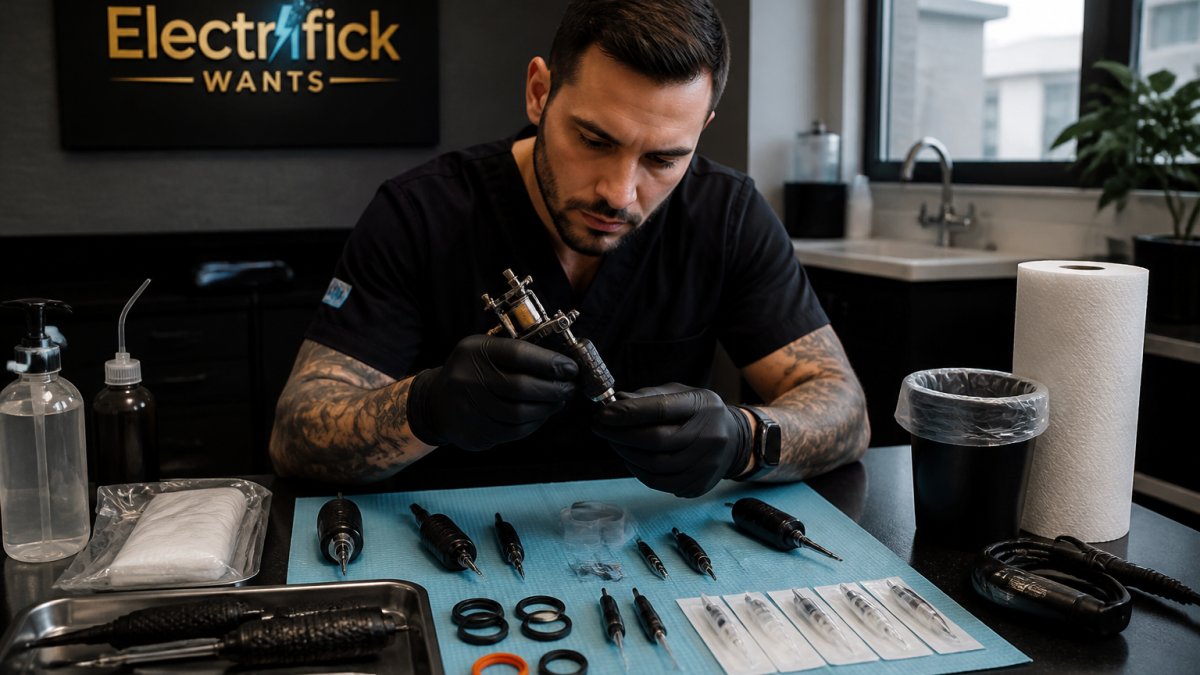
Authenticating a tattoo machine starts with the manufacturer and serial number. Every legitimate professional machine has traceable origins, so contact the manufacturer directly with the serial number to confirm it's real.
Verify the Manufacturer and Serial Numbers
The serial number is your first defense against counterfeits. Locate it on the machine body or power supply, then contact the manufacturer directly, don't rely on seller claims.
Legitimate manufacturers maintain databases of serial numbers. They can tell you:
- Production date
- Original distributor
- Whether the machine is registered
If the manufacturer can't find the serial number, the machine is likely counterfeit. This simple step catches most fakes before you waste money.
Check for Security Features and Packaging
Professional equipment comes with security markers on the packaging and machine:
- Unique scratch-off security numbers
- QR codes linking to manufacturer verification pages
- Holographic labels or tamper-evident seals
According to Instagram and industry standards data from 2026, manufacturers are increasingly implementing QR codes and unique scratch-off security numbers on packaging to combat counterfeiting. Scan the QR code with your phone. It should direct you to the official manufacturer site.
Cheap packaging with blurry logos or spelling errors is a red flag. Legitimate makers invest in professional presentation.
Inspecting Power Supplies and Electrical Components
Your power supply determines machine performance and safety. A faulty power box causes inconsistent needle movement, overheating, and electrical hazards, so verify the electrical side with concrete checks before use.
Verify the U.S. Electrical Safety Markings
Start with the label. A power supply sold for professional use in the United States should carry a recognized certification mark from a Nationally Recognized Testing Laboratory (NRTL), UL, ETL (Intertek), or CSA, confirming testing to a published safety standard such as UL 60950-1 or UL 62368-1.
Check the input rating: most studio power supplies are rated 100-240V AC, 50/60 Hz, so they run on standard U.S. 120V outlets. Confirm a standard NEMA 5-15 three-prong grounded plug, a two-prong plug or adapter suggests it wasn't built for the U.S. market.
Test Voltage Output and Stability
A power supply that looks fine can still deliver unstable voltage. Use a digital multimeter to check the output at the machine connection:
- Set the supply to its lowest and highest voltage settings and confirm the reading tracks the dial or display within about 0.1V.
- Hold a mid-range setting for several minutes and watch for drift; wandering more than a few tenths of a volt under no load is suspect.
- Check the foot pedal and clip cord for continuity, an intermittent connection shows up as a jumping reading when you wiggle the cable.
A stable supply holds its set voltage within a narrow band and returns to the same reading after reconnection. If the reading jumps or the display flickers, the unit needs service or replacement.
Inspect Cables, Connectors, and Grounding
Cables take more abuse than any other part of the setup. Check each one before use:
- Run your hand along the clip cord and foot pedal cable for fraying, cracks, kinks, or exposed wire at the strain relief.
- Confirm the RCA or clip cord connector seats firmly, a loose connector causes intermittent power and inconsistent needle movement.
- Verify the ground prong is intact; never use a cheater plug or adapter to bypass grounding.
Verify Wireless Battery Specifications
For wireless machines, the battery is the power supply. Check the rated capacity in mAh and the charging standard. The Dragonhawk Archer S professional bundle from Electrifick Wants includes a Bluetooth foot pedal with 700mAh battery capacity and Type-C charging, standard specs for reliable professional equipment. A common pattern is for professional wireless pens to ship with batteries in the 1,000-2,000mAh range; confirm the runtime claim matches the capacity and that the charger is a standard USB-C or dedicated dock.

Confirm the Supply Matches Your Machine
Voltage range and connector type must match the machine. Rotary machines typically run on 4-12V; coil machines may need a different range. Confirm the supply's output covers your machine's recommended voltage and that the connector (RCA, clip cord, or proprietary) matches. A supply that can't reach your machine's sweet spot runs hot and wears out faster.
Tattoo Needle and Cartridge Compatibility Guide
Needle and cartridge compatibility determines whether your equipment works together; mismatched components waste money and frustrate your workflow.
Poseidon-S-Luxe Dual Power Tattoo Pen Set – Wireless Freedom Meets Wired →
Cartridge families vary by manufacturer. The major systems include:
| Cartridge Family | Compatibility | Best For | Typical Needle Gauge |
|---|---|---|---|
| Mast/Dragonhawk | Works with Mast machines | Most wireless pens | 1RL to 14M1 |
| Cheyenne | Cheyenne machines only | High-end studios | 1RL to 14M1 |
| Intenze Universal | Universal fit systems | Hybrid setups | Variable |
| Kwadron | Kwadron machines only | Professional shops | 1RL to 14M1 |
Before buying any machine, verify it accepts the cartridges you plan to use via the manufacturer's compatibility chart.
Professional needles are sterilized, consistent, and made from surgical steel. Cheap needles bend, dull quickly, and increase infection risk, so always buy from reputable suppliers.
Tattoo Equipment Safety and Sterilization Standards
Professional equipment must meet sterilization standards, your clients' health depends on it. In the United States, requirements come from several agencies at once, and verifying equipment means knowing which one applies to which item.
Know Which U.S. Regulator Covers Which Item
Equipment verification starts with the right authority:
- FDA regulates tattoo inks as cosmetics and oversees medical devices such as needles and syringes. Check the FDA's recall and import alert pages before stocking a new ink brand.
- OSHA governs workplace safety, including the Bloodborne Pathogens Standard (29 CFR 1910.1030), which requires an exposure control plan, hepatitis B vaccination offers, PPE, and proper sharps handling. Your equipment choices, sharps containers, single-use needles, gloves, are part of compliance.
- State and local health departments license studios and set sterilization and inspection rules. Some states require autoclave spore testing on a set schedule, others specific log formats. Confirm your state's rules before buying equipment that must meet them.
Verify Sterile, Single-Use Components
Needles and cartridges are single-use in professional practice. Verify sterility at the package level:
- Confirm the package is sealed and undamaged, a torn or previously opened sterile pouch is not sterile.
- Check the sterilization indicator (usually a color-change strip or dot) has changed to the 'processed' color.
- Record the lot number and expiration date in your log so you can trace it if a manufacturer issues a recall.
Verify Autoclavable Equipment and Sterilization Cycles
Reusable items, grips, some machine components, and certain tools, must survive autoclave cycles. Confirm the manufacturer states the item is autoclavable and at what temperature and cycle. Stainless steel resists corrosion; aluminum and some plastics do not.
Weekly biological spore testing is recommended to verify that autoclave cycles are achieving sterilization, according to Think Tank Tattoo's 2026 sterilization guide. Most practitioners also keep a written log of each cycle, date, load contents, temperature, pressure, and spore test result, because state inspectors commonly ask for it.
Check Ink Labeling and Safety Data
For tattoo inks, request the Safety Data Sheet (SDS) from the supplier and keep it on file; it lists hazardous ingredients, handling precautions, and first-aid measures. Check the label for manufacturer name, batch or lot number, and expiration date, and cross-check new brands against the FDA's recall and import alert list. Note that 'REACH Compliant' is a European Union standard, not a U.S. requirement, a useful quality signal, but no substitute for FDA labeling and your state's rules.
Verify the Workstation Setup
Equipment verification extends to how the gear is used. Confirm you have:
- A sharps container within arm's reach of the station
- Single-use barriers for clip cords, machine surfaces, and trays
- A clear separation between clean and contaminated areas
Professional Tattoo Equipment Checklist
Use this checklist before making any purchase:
- Serial number verified with manufacturer
- QR code scans to official manufacturer page
- Power supply outputs stable voltage
Spotting Counterfeit Equipment and Unreliable Sellers
Counterfeit machines look almost identical to real ones, but the differences are critical. Watch for:
Red flags in seller behavior:
- Unwilling to provide serial numbers before purchase
- No contact information or vague business address
- Prices significantly below market rate
Red flags in product appearance:
- Blurry or misspelled logos
- Inconsistent branding across components
- Rough edges or poor assembly quality
Verification steps:
- Buy from authorized distributors only
- Check the manufacturer's official distributor list
- Request invoices and proof of purchase
At Electrifick Wants, we curate professional tattoo equipment from verified manufacturers. Our Poseidon-S-Luxe Dual Power Tattoo Pen Set ($218.00) offers dual wireless and wired modes with stable RCA connections for consistent power. Every product we carry includes full manufacturer documentation and warranty support.

As demand increases, so does counterfeiting, your due diligence protects your investment and your reputation.
Frequently Asked Questions
How can you tell if tattoo equipment is professional grade?
Professional-grade tattoo equipment features consistent build quality, manufacturer verification through serial numbers, and compatibility with standard cartridge needles. Check that the machine has a stable power supply, smooth motor operation, and comes with documentation. Verify the seller is legitimate by confirming they stock equipment from recognized manufacturers. The Dragonhawk Archer S and Poseidon Dual Power Tattoo Pen Set, available at Electrifick Wants, exemplify professional standards with their precision motors and universal compatibility.
What should you look for when buying tattoo equipment?
Prioritize authenticity by verifying the manufacturer and checking for security features like QR codes or scratch-off numbers on packaging. Inspect electrical components for damage and test power output. Confirm needle and cartridge compatibility with your chosen machine. Review the seller's reputation and licensing requirements. Check that the equipment meets sterilization standards and comes with proper documentation. Electrifick Wants curates professional tattoo supplies that meet these criteria, including wireless and wired options for different studio setups.
How do you check whether a tattoo machine is authentic?
Verify authenticity by examining the serial number against the manufacturer's database, checking for official packaging with security features like QR codes, and confirming the seller's credentials. Counterfeit machines often have misspelled branding, poor build quality, or missing documentation. Contact the manufacturer directly if you're uncertain. Reputable retailers like Electrifick Wants source equipment from established manufacturers and provide proof of authenticity with every purchase.
How do you know if tattoo supplies are sterile and safe to use?
Verify sterilization by checking that equipment has undergone appropriate sterilization processes. Review the Safety Data Sheet (SDS) for inks and look for proper labeling. Ensure needles and cartridges are individually sealed and unopened. Purchase from licensed retailers who maintain proper storage and handling standards. Professional equipment from Electrifick Wants comes from manufacturers committed to safety standards and sterilization protocols.
Verifying professional tattoo equipment takes time, but it's the only way to protect your investment and your clients. A counterfeit machine fails during sessions, damages your reputation, and wastes money. Legitimate equipment from verified manufacturers delivers consistent performance and safety. At Electrifick Wants, we've vetted every tattoo machine in our collection to ensure authenticity, compatibility, and professional-grade quality. Shop Smart. Shop Electrifick Wants.
