
Best Noise Cancelling Headphones for Audiophiles 2026
Table of Contents
- What Audiophiles Actually Need From Noise Cancelling Headphones
- Active Noise Cancellation vs Passive Isolation: Which Protects Fidelity?
- Hi-Res Audio Wireless Headphones: Codecs, Bitrate, and Sampling Rate Explained
- DAC and Amplifier Requirements for Headphones: What Actually Changes the Sound
- Frequency Response, Total Harmonic Distortion, and Soundstage: Reading the Specs That Count
- Comfort, Build Quality, and Repairability: The Long-Term Audiophile View
- How to Choose the Best Noise Cancelling Headphones for Audiophiles
- Frequently Asked Questions
Last Updated: September 13, 2026
What Audiophiles Actually Need From Noise Cancelling Headphones
Finding the best noise cancelling headphones for audiophiles means accepting a trade-off most reviews ignore: the processing that silences a plane cabin is the same processing that can flatten a soundstage. Customers often seek silence on the commute and neutrality at the desk from one pair. It can't fully deliver both, but it gets close if you know which specifications matter.
Audiophile-grade listening prioritizes fidelity: an uncolored sound profile, wide dynamic range, and imaging that places instruments where the recording intended. Active noise cancellation works against that goal by design: it samples ambient sound with microphones, inverts the waveform, and plays it back through the drivers, effective at low frequencies like engine rumble and HVAC drone, but the correction signal must not smear the music (Evaluating the hearing screening effectiveness of active noise cancellation technology...).
Active Noise Cancellation vs Passive Isolation: Which Protects Fidelity?
Passive isolation preserves fidelity better than active noise cancellation because it blocks sound physically, without touching the audio signal. Thick ear pads, dense foam, and a tight acoustic seal reduce incoming noise before it reaches your ear, no microphones, no DSP, no phase correction.
How ANC Processing Alters the Signal
Active noise cancellation introduces a second signal path: feedforward and feedback microphones capture ambient noise, a DSP chip generates an inverted waveform, and that correction is summed with your music. On well-tuned headphones the audible cost is small; on poorly tuned ones, the correction bleeds into the low end, boosting or hollowing bass, and the constant micro-adjustment can narrow perceived soundstage. Transparency mode adds a third path, piping outside sound through the drivers, useful for conversation, not critical listening.
When Passive Isolation Wins
Passive isolation wins in quiet-to-moderate environments: a home office, a library, an off-peak coffee shop. There, ANC's correction signal does little useful work while still sitting in the signal chain. Many audiophiles keep ANC off for critical listening and engage it only for flights and trains, where its low-frequency attenuation is unmatched.
Hi-Res Audio Wireless Headphones: Codecs, Bitrate, and Sampling Rate Explained
A wireless headphone only delivers hi-res audio if every link in the chain supports it: the source file, the streaming app's output, the OS Bluetooth stack, the codec, the Bluetooth radio version, and the headphone's decoding chip. Break one link and the signal silently falls back to a lower tier, usually with no on-screen warning, the most common reason an audiophile thinks a headphone sounds worse than its spec sheet promises.
What Each Codec Actually Delivers
Bitrate is the ceiling, not the guarantee. These are the practical figures for the codecs you will encounter on ANC headphones sold in the U.S.:
| Codec | Typical Bitrate | Max Sampling Rate | Bit Depth | Best For |
|---|---|---|---|---|
| SBC | ~328 kbps | 48 kHz | 16-bit | Universal fallback; every Bluetooth device supports it |
| AAC | ~256 kbps | 48 kHz | 16-bit | Apple devices; efficient at low bitrates |
| aptX | ~352 kbps | 48 kHz | 16-bit | Older Android; being phased out |
| aptX Adaptive | 279-420 kbps | 48 kHz | 24-bit | Android; adapts to RF congestion and low-latency needs |
| LDAC | 330 / 660 / 990 kbps | 96 kHz | 24-bit | Hi-res streaming on Android; three user-selectable quality tiers |
| aptX Lossless | ~1,000 kbps | 48 kHz | 16-bit | CD-quality lossless when RF conditions allow |
| LC3 / LC3plus | 160-345 kbps | 48 kHz | 32-bit float | LE Audio; better quality per bit than SBC |
Two things trip people up. LDAC's 990 kbps mode is fragile, in a crowded RF environment the headphone drops to 660 or 330 kbps, audible on dense material. And aptX Lossless only stays lossless when the link is clean; under congestion it falls back to a lossy profile without telling you.
Bluetooth Version and the ANC Interaction
Bluetooth 5.0 through 5.4 all support the same audio codecs in practice, the version number mostly governs connection stability, multipoint behavior, and LE Audio support. Bluetooth 5.2 and later can carry LC3 and Auracast, which matter more for future-proofing than current sound quality.
The audiophile-specific wrinkle: ANC processing runs on the headphone's DSP, and on some models the ANC filter and codec decoder share the same chip. When ANC is engaged, a few headphones quietly reduce the codec's effective bitrate or disable the highest LDAC tier to free processing headroom, rarely documented. To check, play a familiar high-frequency-rich track (cymbals, strings) with ANC on and off and listen for lost air or shimmer.
Wired Mode Is Not Automatically Better
Most ANC headphones include a 3.5 mm analog input, but on many models the analog signal is re-digitized, run through the same DSP, and converted back to analog, so you inherit the ANC tuning even with the cable plugged in. A smaller number offer a true analog bypass that routes the signal straight to the drivers. If wired critical listening matters, confirm whether the headphone has a passive/analog mode and whether it works with the power off.
USB-C audio is a third path. When a headphone accepts USB-C digital audio, its internal DAC does the conversion, better or worse than your phone's depending on the chip inside, and it usually enables charging while listening.
DAC and Amplifier Requirements for Headphones: What Actually Changes the Sound
Most buying guides treat DAC and amp pairing as a simple rule: high impedance needs an amp, low impedance does not. That rule was written for passive wired headphones. ANC headphones break it, because their internal signal path differs from a passive headphone's, the most overlooked issue for audiophiles using ANC cans with high-fidelity gear.
The Thresholds That Actually Matter
For passive headphones, the practical dividing lines are well established:
- Under 32 ohms with sensitivity above 100 dB/mW, a phone or laptop drives these to full volume with headroom to spare. An external amp adds little.
- 32-80 ohms with sensitivity around 95-100 dB/mW, portable sources work but may run out of voltage on dynamic peaks. A small portable DAC/amp helps.
- Above 80 ohms, or sensitivity below 95 dB/mW, a dedicated amp is not optional. Without one you get thin bass, compressed transients, and a volume ceiling that forces you to listen near the noise floor of your source.
ANC headphones almost always sit in the first category, they are designed to be driven by a phone. So the honest answer to "do I need a DAC and amp for my ANC headphones?" is: not for power. But that is not the whole story.
The ANC Signal-Path Problem
Inside a typical ANC headphone, the audio path looks like this:
- Bluetooth or analog input
- Analog-to-digital conversion (if the input was analog)
- DSP stage, ANC filter, EQ, sometimes codec decoding
- Digital-to-analog conversion
- Amplification to the drivers
If you plug a high-end external DAC and amp into the 3.5 mm jack of a headphone that follows this path, your signal is converted to analog by your DAC, sent down the cable, immediately re-digitized by the headphone's ADC, run through its DSP, converted back to analog by its internal DAC, and amplified by its internal amp. You have added a conversion stage, not removed one. In most cases the headphone's internal DAC and amp are the bottleneck, and your external gear only adds noise and latency.
A small number of ANC headphones offer a true analog bypass, the 3.5 mm signal goes straight to the drivers with the DSP out of the loop, sometimes only when powered off. These are the models where an external DAC and amp genuinely change the sound. If a headphone does not advertise a passive or analog mode, assume the DSP is always in the path.
What Actually Improves ANC Headphone Sound
Given that, the useful upgrades for an audiophile using ANC headphones differ from the usual advice:
- A portable DAC/amp with a wired USB-C or Lightning output to the headphone's digital input, if the headphone accepts digital USB audio. This bypasses the phone's DAC and lets the headphone's internal DAC do the work, only an upgrade if the headphone's DAC is better than the phone's, which is not guaranteed.
- A source that supports the codec the headphone prefers. If your headphone supports LDAC and your phone does not, a portable Bluetooth transmitter or a different source device will do more for sound quality than any amp.
- A wired connection with ANC off, on a headphone that has a true analog bypass. This is the only configuration where an external DAC and amp are unambiguously beneficial.
Matching Output Impedance
One spec that matters even for easy-to-drive headphones: the amplifier's output impedance. The rule of thumb is that output impedance should be no more than one-eighth of the headphone's impedance, for a 32-ohm headphone, an amp under 4 ohms (edu). Many budget amps and some laptop jacks exceed this, tilting the frequency response (usually a bass boost and treble lift) audibly and measurably. For ANC headphones with internal amplification, this matters mainly in the analog-bypass case, but check it if you plan to use a wired connection.
Headphone output impedance and damping factor explained
Frequency Response, Total Harmonic Distortion, and Soundstage: Reading the Specs That Count
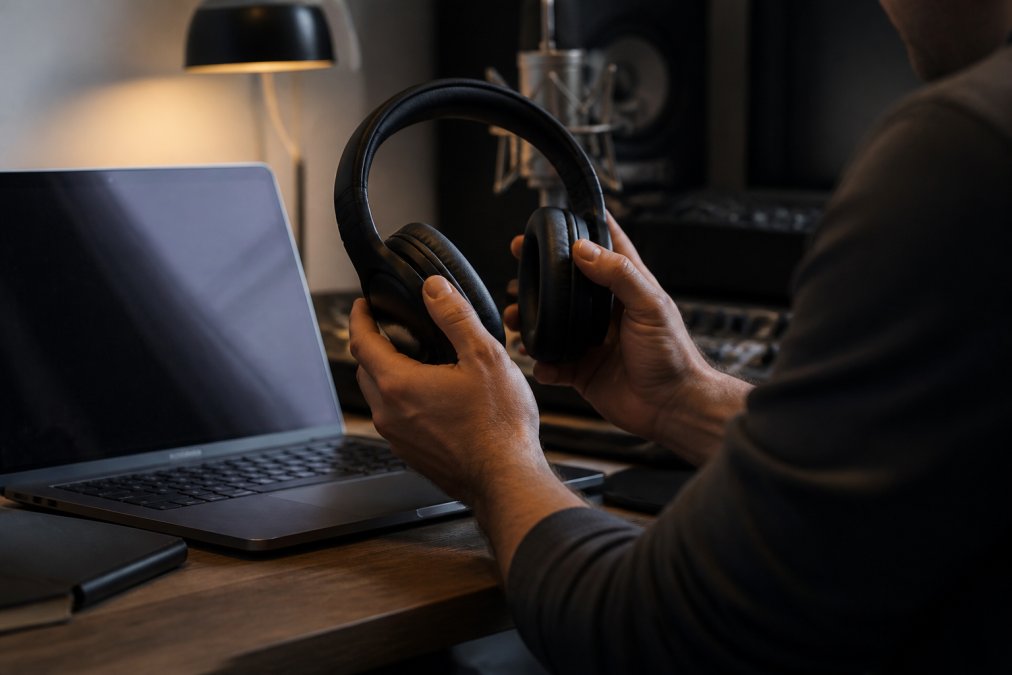
Three specifications separate a genuinely audiophile-grade headphone from a consumer one: frequency response, total harmonic distortion, and soundstage.
Frequency response describes the range of audible frequencies a headphone reproduces and how evenly. A flat response is the audiophile ideal, though most headphones deviate somewhere; a neutral signature means no band is artificially boosted, which matters for critical listening.
Total harmonic distortion measures unwanted harmonics added to the signal, as a percentage. Lower is better; above roughly one percent it becomes audible as harshness or muddiness, particularly in the low end where ANC processing is most active.
Soundstage describes the perceived width and depth of the audio image. Closed-back headphones, which ANC models almost always are, produce a narrower soundstage than open-back designs because the sealed cup reflects sound back into the ear. Imaging, placing individual instruments precisely, is closely related and equally affected by the acoustic seal.
Comfort, Build Quality, and Repairability: The Long-Term Audiophile View
Comfort and durability decide whether a pair survives years of daily use; repairability decides whether it survives the first failure. Clamping force is the most underestimated variable: too much pressure causes headaches within an hour, too little breaks the acoustic seal and undermines both passive isolation and bass response.
Ear cup material matters for comfort and sound. Memory foam wrapped in protein leather traps heat but seals well; fabric covers breathe better but can leak low frequencies. Over-ear designs distribute weight more evenly than on-ear models, which is why most audiophile ANC headphones use that form factor.
Repairability is where the industry falls short. Many ANC headphones seal batteries and drivers inside glued housings, making a worn pad or degraded battery a reason to replace the whole unit. Before buying, check whether replacement ear pads and cables are sold separately, that detail often determines whether a headphone lasts three years or ten.
How to Choose the Best Noise Cancelling Headphones for Audiophiles
Choosing the best noise cancelling headphones for audiophiles comes down to matching the headphone's strengths to where you actually listen:
- Confirm the codec support matches your phone and streaming service
- Check impedance and sensitivity against your source device
- Test ANC on and off with a familiar track before committing
- Verify replacement ear pads and cables are available
- Confirm multipoint connectivity if you switch between devices
- Check the return window in case the sound profile does not suit you
A common mistake is buying for the spec sheet rather than the use case. A headphone tuned for maximum noise reduction on a plane will not flatter acoustic recordings at a desk. If your listening is split evenly, prioritize the environment where you listen most.
Our audio selection focuses on trusted brands and honest specifications, so you can compare models on the details that affect fidelity rather than the ones that affect the box. Free shipping on orders over $50 makes it easier to test a pair at home, where the real listening happens.
Frequently Asked Questions
Can noise cancelling headphones provide true audiophile sound quality?
Yes, with caveats. Modern ANC headphones from brands like Bose and Sony use digital signal processing that can be bypassed or tuned, and many support hi-res codecs such as LDAC and aptX Adaptive. The ANC circuit itself introduces slight distortion in some models, but flagship options keep total harmonic distortion low enough for critical listening. The trade-off is that ANC often narrows soundstage compared to open-back wired headphones, so audiophiles who prioritize imaging may prefer passive isolation or a transparency mode for quieter environments.
Are wired or wireless headphones better for audiophile sound?
Wired still holds an edge for pure fidelity. A wired connection avoids Bluetooth codec compression, and pairing with a dedicated DAC and amplifier can deliver higher dynamic range and lower noise floor. That said, hi-res audio wireless headphones using LDAC or aptX Lossless now stream at bitrates close to CD quality, which is enough for most listeners. If you want the best noise cancelling headphones for audiophiles and also need portability, a model with both wired and wireless modes gives you the flexibility to switch based on the source.
How does active noise cancellation affect audio fidelity?
ANC works by generating inverse sound waves to cancel ambient noise, which requires digital signal processing. This processing can slightly alter the frequency response and reduce soundstage width in some implementations. The effect is most noticeable in the upper mids and treble, where some listeners report a smoother but less airy presentation. Higher-end models mitigate this with dedicated audio chips and allow you to disable ANC entirely for critical listening, preserving the original tuning.
What should I look for in a DAC and amplifier for noise cancelling headphones?
Match the DAC and amp to your headphone's impedance and sensitivity. Most ANC headphones are low-impedance and easy to drive, so a portable DAC with a low output impedance (under 1 ohm) and enough power for the headphone's sensitivity rating is sufficient. Look for support for high-resolution audio formats up to 24-bit/192kHz and a signal-to-noise ratio above 110dB. If you plan to use wired mode frequently, a dedicated amp can tighten bass control and improve dynamic range.
The hard part is not finding a headphone with strong noise cancellation. It is finding one that cancels noise without quietly rewriting the music. Electrifick Wants carries a curated range of premium audio gear from brands like Bose and Sony, with fast and reliable shipping and free shipping on orders over $50, so you can compare options and settle on the pair that suits your ears. Shop Smart. Shop Electrifick Wants.
