

Table of Contents
- Start With Your Tattoo Machine: Compatibility Checks Before You Buy
- Tattoo Needle Cartridges vs Traditional Needles: Which Setup Fits Your Work
- Tattoo Needle Configurations: Round Liner, Round Shader, and More
- The Best Tattoo Needles for Beginners: Simple Setups That Work
- How to Verify Sterility and Authenticity Before You Buy Tattoo Needles Online
- Receiving, Storing, and Disposing of Your Needle Supply
- Conclusion: Ordering the Right Needles With Confidence
- Frequently Asked Questions
Last Updated: October 7, 2026
Start With Your Tattoo Machine: Compatibility Checks Before You Buy
Before buying high quality tattoo needles online, verify your machine. A cartridge that doesn't seat properly will wobble, spray pigment, and ruin a clean line.
Tattoo needles are the disposable tips that deliver pigment into the skin, and they only perform when the connection to your machine is solid.
Here's what to check before you add anything to a cart:
- Grip and cartridge system: Standard cartridge grips, twist-lock grips, and pen-style machines each accept different cartridge bases. Confirm the base style your machine uses.
- Membrane type: Some machines require a specific membrane thickness to drive the needle smoothly. A mismatched membrane causes drag and inconsistent depth.
- Throw and stroke: Your machine's stroke length should match the needle's intended use. Long-stroke machines suit lining; short-stroke rotary pens suit shading and packing.
A common mistake is assuming all cartridges are universal. They aren't.
Tattoo Needle Cartridges vs Traditional Needles: Which Setup Fits Your Work
Cartridge needles come pre-assembled in a plastic housing, while traditional needles must be soldered onto a bar and paired with a separate tube.
Tattoo needle cartridges are the modern default.
Traditional needles require attaching the needle to a bar and sliding it into a tube.
Here's how the two compare:
| Factor | Cartridge Needles | Traditional Needles |
|---|---|---|
| Setup time | Seconds, click-in | Slower, manual assembly |
| Hygiene | Sealed, single-use housing | Requires separate sterile tube |
| Handling | Minimal contact | More exposed-needle handling |
| Best for | Most modern setups | Artists who prefer full control |
| Flexibility | Fixed configurations | Custom bar and tube pairing |
For a new artist, cartridges remove a layer of error. For a veteran with a favorite tube and bar combination, traditional needles still make sense.
Tattoo Needle Configurations: Round Liner, Round Shader, and More
Tattoo needle configurations describe how individual needles are arranged in a group, and that arrangement decides whether you line, shade, or pack color. Choosing wrong is why lines blur or shading looks patchy.
The main configurations you'll see:
- Round liner (RL): Needles clustered tightly in a circle. Built for clean, bold outlines and precision work.
- Round shader (RS): Needles arranged in a looser circle. Used for shading, blending, and soft edges.
- Magnum (M1, curved magnum): Needles set in a flat or curved row. Covers more area for color packing and large shading.
A needle grouping is written as a number plus letters, such as 3RL or 9M1. The number tells you how many needles are in the group; the letters tell you the configuration.
A Decision Guide: Match the Configuration to the Task
Most shopping pages list configurations without saying which to grab for a given job. Use this as a starting point, then adjust to your hand speed and machine stroke.
| Task | Configuration | Typical Diameter | Typical Taper | Why It Works |
|---|---|---|---|---|
| Fine linework, script, single-needle detail | 1RL, 3RL | 0.25-0.30 mm | Short | Tight cluster holds a crisp edge with minimal pigment spread |
| Standard outlines | 5RL, 7RL | 0.30-0.35 mm | Short to medium | Enough needles to saturate a bold line in one pass |
| Soft shading and blending | 5RS, 7RS, 9RS | 0.30-0.35 mm | Medium | Looser circle diffuses pigment for smooth gradients |
| Small color packing | 7RS, 9RS | 0.35 mm | Medium | Covers area without the width of a magnum |
| Large color packing and shading | 9M1, 13M1, 15M1 | 0.35-0.40 mm | Long | Flat row lays down broad, even pigment fields |
| Whip shading and texture | 9M1, 11M1 (curved) | 0.30-0.35 mm | Long | Curved edge feathers pigment for soft transitions |
Treat the numbers as ranges, not rules. A 0.30 mm 3RL and a 0.35 mm 3RL behave differently in the same hand, and a long taper on a liner flexes more than a short taper.
Diameter and Taper: The Two Specs That Change Everything
Diameter is the thickness of each needle in the group. Taper is how far the point narrows before the tip. Together they control pigment flow, line weight, and how the needle feels in the skin.
- Thinner diameter (0.25-0.30 mm): Less pigment per pass, finer lines, more passes required. Best for detail and delicate work.
- Thicker diameter (0.35-0.40 mm): More pigment per pass, bolder lines, fewer passes. Best for outlines, packing, and coverage.
- Short taper: Stiffer point, more control, less pigment held. Good for crisp lining.
What most guides miss: taper affects ink flow as much as diameter. A long taper holds more pigment but flexes more, softening a line if your hand speed is off.
Grouping Size: How Many Needles Do You Actually Need?
Grouping size is the number in front of the letters. More needles means more coverage per pass, but also more drag and a wider footprint.
- 1-3 needles: Detail, fine lines, small text.
- 5-9 needles: Standard outlines, small shading, small packing.
- 11-15 needles: Large shading, broad color fields, background work.
- 17+ needles: Very large coverage areas, often on back pieces and sleeves.
If unsure, buy an assorted pack spanning 3RL through 9M1. Run test passes on practice skin, note which grouping feels natural for each task, then order those in bulk.
The Best Tattoo Needles for Beginners: Simple Setups That Work
The best tattoo needles for beginners are round liners for outlines and round shaders for shading, in a small range of common sizes.
Shop Smart. Shop Electrifick Wants. →
Start with a minimal kit:
- 3RL and 5RL round liners for fine and standard outlines
- 5RS and 7RS round shaders for shading and smaller color work
- 7M1 or 9M1 magnums once you're ready for larger color packing
Buy these as assorted sets or small boxes first, so you can test configurations without committing to a full box of one size.
Brand matters less than consistency at this stage. Look for sharpness out of the package, smooth performance, and sterile, single-use packaging.
How to Verify Sterility and Authenticity Before You Buy Tattoo Needles Online
Sterility and authenticity are non-negotiable when you buy high quality tattoo needles online. A needle that isn't genuinely sterile, or that's a counterfeit, puts your client at risk.
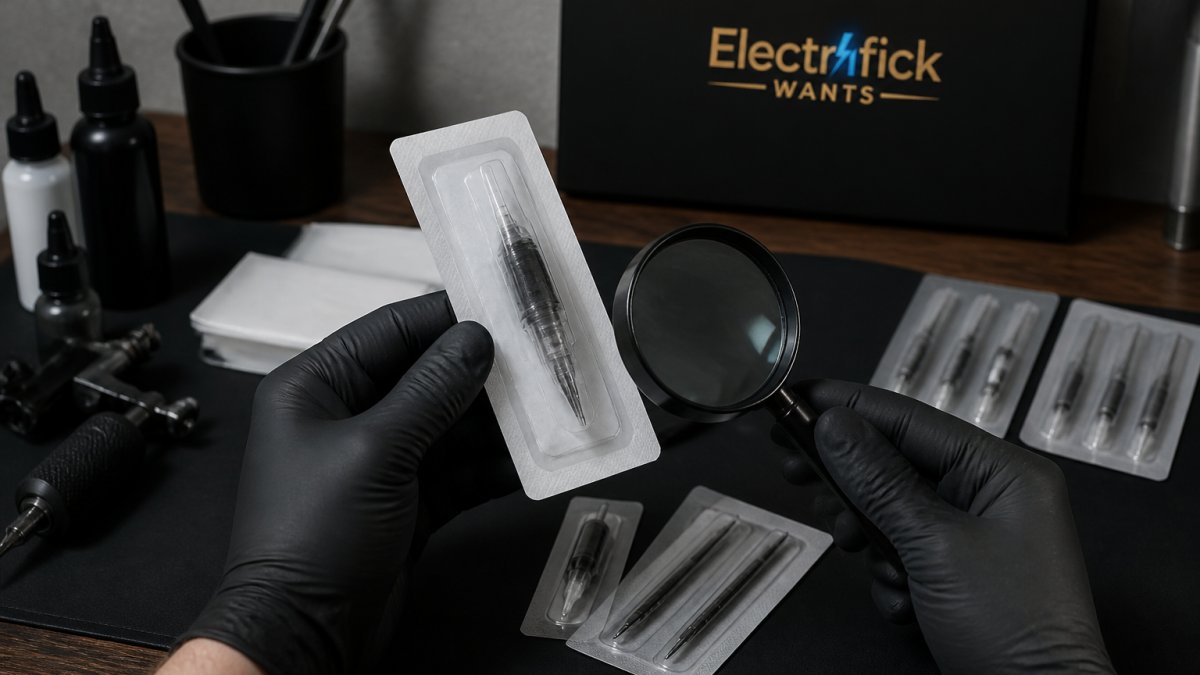
What a Legitimate Sterile Package Looks Like
A properly sterilized needle or cartridge arrives in an intact, sealed, single-use wrapper. The seal should be continuous with no wrinkles, lifted edges, or resealed tape.
Look for a sterilization indicator, usually a color-changing strip or dot confirming the process was completed. It should show the post-sterilization color, not the pre-process color. If it's missing or unchanged, treat the package as unsterile.
Label Details That Separate Real Products From Counterfeits
Run this checklist every time you order:
- Manufacturer name and address: A legitimate product names the manufacturer or distributor. Vague "premium" listings with no company behind them are a red flag.
- Sterilization method: Look for the method used, such as ethylene oxide (EO) or gamma irradiation. This is a standard label element on medical-grade sterile devices.
- Lot or batch code: Legitimate products carry a traceable lot number so the manufacturer can track the sterilization run. No lot code means no traceability.
- Expiration date: Check the date and reject anything expired or close to it. Sterile packaging has a shelf life.
How to Check Seller Reliability Before You Buy
Product quality only matters if the seller is legitimate. Before ordering, check:
- Credentials and contact information: A real business lists a physical address, a phone number, and a working support channel. A contact form alone is not enough.
- Return and hygiene policy: Many sellers won't accept opened hygiene products for return, which is reasonable. But a seller should clearly state the policy before checkout, not after a problem.
- Shipping and handling: Sterile products should ship in packaging that protects the seal. Crushed or punctured wrappers on arrival are a sign of poor handling.
- Traceability: Can the seller tell you the manufacturer and lot number of the stock they ship? If not, you can't verify authenticity.
The U.S. Occupational Safety and Health Administration bloodborne pathogens standard requires that employers provide safe equipment and follow exposure-control practices, which is exactly why single-use, sterile needles matter in any professional setting.
Receiving, Storing, and Disposing of Your Needle Supply
How you handle needles after delivery decides whether they stay sterile and sharp. Good receiving and storage habits protect every session that follows.
When a shipment arrives, inspect it before putting anything away:
- Check that every package is sealed and undamaged
- Confirm expiration dates and batch codes match your order
- Reject any box that shows signs of moisture, crushing, or tampering
Store needles in a cool, dry place away from sunlight and moisture.
For disposal, treat every used needle as contaminated. Place used needles in a dedicated sharps container, never in general trash, and follow local rules for sharps disposal.
Conclusion: Ordering the Right Needles With Confidence
Getting the right needles comes down to three things: matching them to your machine, choosing the right configuration for the task, and verifying they're genuinely sterile before they touch skin.
At Electrifick Wants, we stock specialized tattoo equipment alongside our curated electronics, with a focus on quality brands and reliable, fast shipping.
Shop smart. Shop Electrifick Wants, and order the needles your work deserves.
Frequently Asked Questions
Who makes the best tattoo needles?
There is no single best brand, but reputable manufacturers use 316L or 304 stainless steel, laser-verify sharpness, and package each needle in a sealed, sterile blister pack with a lot number and expiration date. Look for brands that publish their sterilization method (usually gamma or ethylene oxide) and offer consistent sizing. On Electrifick Wants, the curated selection focuses on needles that meet these quality markers, so you can compare configurations and cartridges without sorting through unverified listings.
What should I check before buying tattoo needles online?
Before you buy high quality tattoo needles online, confirm four things: (1) the needle type fits your machine or grip, (2) the configuration (round liner, round shader, magnum) matches your task, (3) the packaging is sealed and labeled sterile with an expiration date, and (4) the seller has a clear return policy for unopened items. Also check whether the listing specifies needle diameter and taper, since those details affect lining precision and shading coverage. If any of these are missing, ask the seller before ordering.
Are tattoo needle cartridges compatible with every tattoo machine?
No. Cartridges use a membrane and a specific drive bar shape that must match your machine's grip and stroke. Most rotary machines accept standard cartridge grips, but some coil machines and older rotary models need an adapter or a different grip. Before ordering, check your machine's manual or the grip you use, and confirm the cartridge brand lists compatibility. If you are unsure, buy a small assorted set first to test fit before committing to a full box.
How do I choose the right tattoo needle configuration?
Match the configuration to the job. Round liners (tight grouping) are for clean outlines and fine detail. Round shaders (looser grouping) work for small shading and color packing in tight areas. Magnums and curved magnums cover more skin quickly for large shading and color packing. For beginners, a starter set with 3RL, 5RL, 7RS, and 9M1 covers most practice work. Needle diameter also matters: thinner diameters (0.25 mm, 0.30 mm) suit fine lines, while 0.35 mm and up handle bolder work and larger pigment loads.