
How to Choose Scuba Diving Fins: 2026 Buyer's Guide
Table of Contents
- Start With Your Dive Environment, Not the Fin
- Full-Foot vs Open-Heel Fins: Which Style Fits Your Diving?
- Blade Stiffness, Material, and Propulsion: What Actually Moves You
- Scuba Fin Sizing Guide: How to Get the Fit Right
- Matching Fins to Your Fitness and Diving Style
- Scuba Diving Gear Maintenance Tips for Fins and Straps
- Troubleshooting Common Fin Problems
- Frequently Asked Questions
Last Updated: September 16, 2026
Start With Your Dive Environment, Not the Fin
Most buyers open a product page, scroll to the specs, and start comparing blade lengths. That is the wrong order. The right way to learn how to choose scuba diving fins is to start with where you actually dive, because water temperature, current, and entry style decide more about the correct fin than any spec sheet. We see a common pattern in customer questions: people pick a fin they like the look of, then discover it fights them on every descent.
Full-Foot vs Open-Heel Fins: Which Style Fits Your Diving?
Full-foot fins slip directly onto a bare foot, while open-heel fins use an adjustable strap and are worn over neoprene boots. The choice comes down to water temperature, shore entries, and how much walking your dive site involves.
When Open-Heel Fins Make Sense
Open-heel fins are the standard for cold water, boat diving, and any site where you walk across rock or pavement before entering. The foot pocket is roomier, the heel strap adjusts, and boots add insulation plus protection underfoot. Spring straps, a coiled metal replacement for rubber straps, are a common upgrade because they slide on and off without fiddling.
When Full-Foot Fins Win
Full-foot fins are lighter, pack flatter, and suit warm tropical diving where you enter from a boat or a sandy beach in bare feet. With no boot and no strap, there is less to break and less to adjust. What most guides miss is that a full-foot fin only works if the pocket fits your foot precisely, since there is no strap to compensate for a loose heel.
| Fin Style | Best For | Footwear | Packability |
|---|---|---|---|
| Open-heel | Cold water, shore entries, boat diving | Neoprene boots | Bulkier |
| Full-foot | Warm water, boat and sandy entries | Bare foot | Compact |
Blade Stiffness, Material, and Propulsion: What Actually Moves You
Blade stiffness determines how much leg strength a fin demands and how much thrust it returns. A stiff blade moves more water per kick but loads the legs harder; a soft blade is forgiving but delivers less push against current.
Paddle vs Split-Fin Design
A paddle fin has one solid blade and produces thrust through a wide, powerful stroke, which suits frog kicks and technical diving. A split-fin has a V-shaped notch that channels water through the center, reducing resistance on the recovery stroke and easing leg fatigue. Split fins feel easier over long, steady flutter kicks. Paddle fins win when you need raw power in current or precise maneuverability near a wreck or cave line.
Scuba Fin Sizing Guide: How to Get the Fit Right
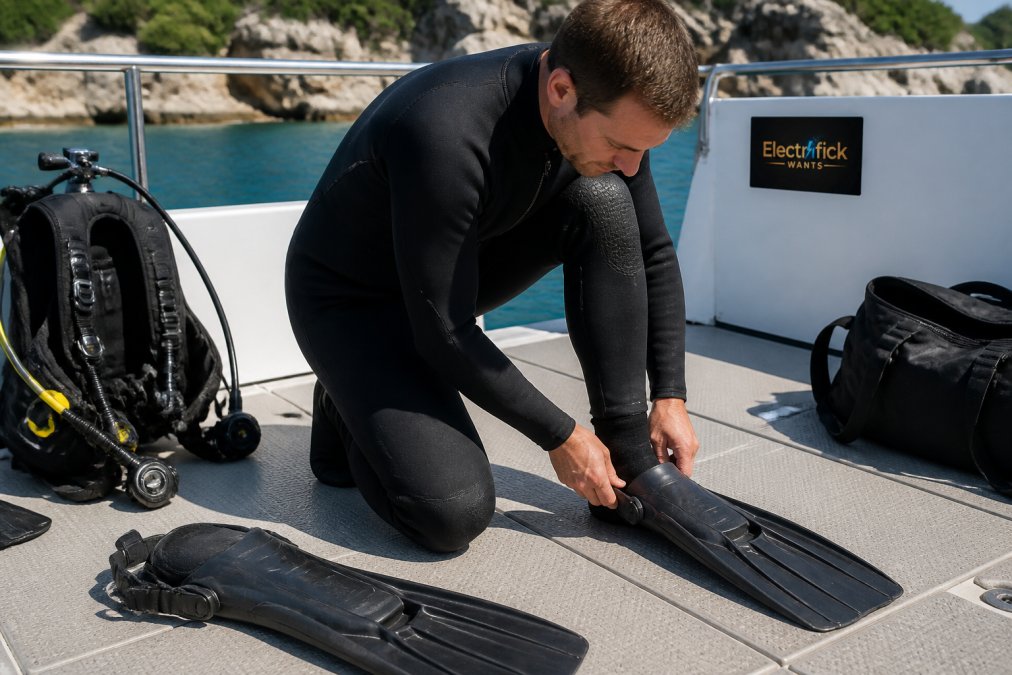
Fit is the single most common reason fins get returned, and it is also the hardest thing to judge from a product page. A correct fit means your toes reach the end of the pocket without curling, your heel sits fully seated, and no part of the fin rubs during a full kick cycle. Get any one of those wrong and you will feel it within twenty minutes of entering the water.
Measure Before You Compare Charts
Manufacturer size charts assume a bare foot, but most open-heel divers wear boots. That mismatch is where sizing goes wrong. Measure your foot in the exact footwear you dive in:
- Stand on a sheet of paper with your heel against a wall.
- Mark the tip of your longest toe (not always the big toe).
- Measure heel-to-toe in inches, then measure the widest part across the ball of your foot.
- Measure your boot's sole thickness at the heel and add it mentally to the pocket depth you need.
The Fit Checks That Actually Predict Problems
Work through these before you buy, and repeat them with the boots you actually dive:
- Wear the exact boots or socks you dive in, not street shoes
- Confirm your toes touch the front without bending or curling
- Check that the heel strap sits centered, not riding up the Achilles
- Press down on the top of the pocket to feel for pressure over the instep
- Walk a few steps to feel for hot spots at the heel and arch
- Test a full kick cycle, not just a static fit
Reading the Trade-Offs
Sizing varies between manufacturers, so treat every brand's chart as a starting point rather than a rule. A few patterns hold across most brands:
- Between sizes in open-heel: size up. The strap and boot give you room to take up slack, and a tight pocket causes cramping.
- Between sizes in full-foot: stay true to size or size down slightly. There is no strap to compensate, so a loose heel means the fin slides off mid-kick.
- Wide feet: look for a pocket described as roomy or a brand known for a wider last; a narrow pocket will pinch the instep no matter the length.
- High arches: a pocket with a flatter footbed reduces arch cramping, which is one of the most common fit complaints.
Why This Matters More Than the Spec Sheet
A fin that fits correctly transfers your leg force into the blade with almost no wasted motion. A fin that fits poorly forces you to grip with your toes, which is the direct cause of most arch cramps and toe blisters. If you can only get one thing right when learning how to choose scuba diving fins, get the fit right first and let everything else follow.
Shop Smart. Shop Electrifick Wants. →
Matching Fins to Your Fitness and Diving Style
Most guides treat fin stiffness as a preference. It is closer to a physical match, and getting it wrong is the fastest route to cramping, fatigue, and a fin that sits in the closet. Leg strength and kick style matter more than most buyers expect, and almost no guide explains the mechanism behind the recommendation.
How Stiffness Loads Your Legs
A stiff blade resists bending, so every kick recruits more of your quadriceps, hip flexors, and ankle stabilizers to push it through the water. That resistance is what returns thrust, but it also returns force into your joints. A soft blade bends earlier, so the same kick costs less energy and produces less push. Neither is better in the abstract.
A useful self-assessment before you buy:
- Dive frequency: A few trips a year usually points to a softer or split blade; weekly diving gives your legs the conditioning to handle stiffer blades.
- Kick style: Flutter kick rewards a softer, more flexible blade. Frog kick and back kick reward a stiffer paddle that holds its shape under load.
- Cramp history: If you cramp in the arch or calf, treat it as a signal to go softer, not to push through.
- Current exposure: Regular drift or current diving justifies more stiffness than calm reef diving.
- Leg length and leverage: Longer legs generate more torque, so they can often drive a stiffer blade than shorter legs with similar strength.
Match the Kick to the Fin, Not the Other Way Around
Kick style is the variable most divers never think about, yet it changes which fin works:
- Flutter kick is the default recreational stroke. It is efficient with a moderately soft blade and a split design, and it is the stroke most beginners learn first.
- Frog kick is the standard for technical and cave diving because it produces thrust without stirring silt and keeps the diver flat in trim. It needs a stiffer paddle fin that loads evenly across the blade.
- Back kick is used for precise positioning near a wreck or line. It demands a paddle fin with enough stiffness to reverse direction cleanly; split fins are poor at it.
- Modified flutter and scissor kicks sit between the two and generally favor a mid-stiffness blade.
Recreational vs Technical Profiles
Your dive profile should guide the choice as well. A recreational diver logging shallow reef dives in warm water has different needs than someone working a deep wreck with a stage bottle. Technical diving adds task loading, longer bottom times, and a need for precise trim, all of which favor a stiffer paddle fin and a frog kick.
Scuba Diving Gear Maintenance Tips for Fins and Straps
Rinse fins in fresh water after every saltwater dive, dry them out of direct sun, and store them flat rather than folded. Salt crystals abrade rubber over time, and UV breaks down both rubber and thermoplastic.
Troubleshooting Common Fin Problems
Most fin complaints trace back to fit or technique, not a defective product. Here is how to diagnose the usual issues.
| Problem | Likely Cause | Fix |
|---|---|---|
| Cramping in the arch | Foot pocket too tight | Size up or switch to open-heel |
| Heel slipping out | Strap too loose or wrong boot thickness | Adjust strap or change boot |
| Leg fatigue after 20 minutes | Blade too stiff for your strength | Move to a softer or split blade |
| Blisters on the toes | Pocket too long | Add a neoprene sock or resize |
| Poor trim in the water | Fin buoyancy mismatched | Test a lighter or heavier blade |
Frequently Asked Questions
What is the difference between full-foot and open-heel fins?
Full-foot fins have a closed heel pocket that fits bare feet or thin socks, making them lighter and cheaper for warm-water snorkeling and tropical diving. Open-heel fins have an adjustable strap and require neoprene boots, which keeps feet warm in cold water and handles shore entries over rocks. If you dive in a thermocline or travel between climates, open-heel gives you more versatility.
Do I need stiff or flexible fins for scuba diving?
It depends on your leg strength and dive profile. Stiff blades deliver more thrust per kick but tire your legs faster, which suits strong swimmers doing current-heavy dives. Flexible blades are easier on the knees and better for long, relaxed dives or beginners still building leg endurance. Most recreational divers do well with a medium-stiffness paddle fin.
Are heavier or lighter fins better for scuba diving?
Lighter fins reduce leg fatigue and pack easily for travel, but they can feel less powerful against strong current. Heavier fins, often rubber, give more thrust and better hydrodynamics at the cost of weight and bulk in your bag. Your choice should match your dive environment and how much you value portability versus propulsion.
How do I find the right scuba fin size?
Measure your bare foot or your foot inside the neoprene boot you plan to wear, then check the manufacturer's size chart, since sizing varies by brand. The fin should feel snug without pinching your toes or heel. If you are between sizes, size up for open-heel fins with boots and stay true to size for full-foot fins.
